Opinions of Value: Live closed out the year with a look inward. After our first two sessions asked where the profession stands and what lenders really want from a report, the third session turned the lens on the firm itself.
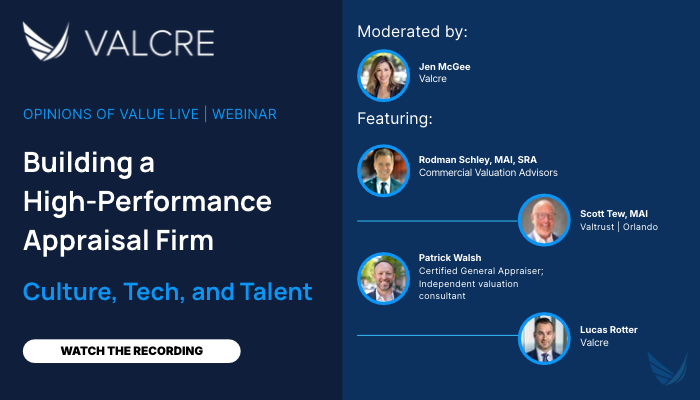
“Building a High-Performance Appraisal Firm: Culture, Talent and Tech” brought together firm founders and operators to talk about who to hire, how to train them, where technology actually earns its keep, and what holds a team together when nobody shares an office.
Who was in the room
Jen McGee, Valcre’s Senior Director of GTM Operations, moderated the discussion. She was joined by:
- Rodman Schley, MAI, SRA, CEO, Commercial Valuation Advisors
- Scott Tew, MAI, Executive Managing Director, Valtrust | Orlando
- Patrick Walsh, Certified general appraiser, Independent valuation consultant
- Lucas Rotter, CEO and Co-Founder, Valcre
Rodman, Scott and Patrick all returned from our debut session, and between them have built, run and sold appraisal firms.
What separates high performers, in a sentence
Jen opened by asking what separates a high-performing firm from an average one. Rodman said the ability to evolve: firms that don’t keep pace with fast-moving technology may simply go away. Patrick pointed to scalability, built on locked-in processes and policies, with an exit in mind from day one. Scott highlighted doing the work well and letting judgment drive it, because “the reward for work well done is the opportunity to do more.” Lucas brought up consistency: the best firms deliver “the same quality in their busiest week as their slowest.”
Hire for appetite, train from the ground up
Rodman’s best people have always come up through his own training, often as second careers. Two of the best appraisers he ever had were former Marines. Scott takes a similar approach, hiring bright degree holders and teaching them appraisal. The difference between trainees who make it and those who don’t, he said, is appetite. One of his trainees was signing reports alongside him within 12 months and certified within two years. Two others never got there after nearly two years, and Scott was candid that the trainer shares some of the blame.
Rodman usually knows within three to six months whether someone will work out, and urged mentors to dig into exactly where a trainee isn’t grasping the material rather than looking only at the big picture. Lucas said the hardest step isn’t building a report, it’s defending the conclusion, which means learning to be a skeptic of your own work. Patrick’s advice for new appraisers: respect everyone’s time. “If somebody comes into a firm and they save you time… that person is gonna stick around.”
Don’t fear training your competition
Every panelist has lost a newly licensed appraiser, and none of them regret training them. “Don’t ever be afraid to train your competition,” Rodman said, noting that some of his best bank clients once worked for him. But when someone leaves for another firm, ask the hard question: “What am I not providing?” Lucas added that losing someone to a lender is partly a sign you trained them well.
Technology: repeatable work vs. judgment
Patrick drew the line clearly. Technology pays off on data entry, sifting market data, working through a 50-page lease, and flagging conflicts between sources, like a parcel size that differs between the assessor and the survey. Where it becomes dangerous is putting technology between the appraiser and the value conclusion. Scott praised report writing software for building a comp database with every assignment, but warned that templates can’t cover every scenario: “You got me halfway there, but I’m going to have to rewrite this.”
Rodman pushed back on the hype. Building AI tools is powerful, but it isn’t easy. “Don’t lead with AI. AI should be your partner.” Patrick seconded it: if you’re finding it difficult, you’re not doing it wrong.
Lucas shared three habits of firms that get real value from technology: start with the problem, not the tool; standardize before you automate, because “if 10 appraisers build a report 10 different ways, software is just gonna speed up that inconsistency”; and make one person own adoption and measure it. Scott added that technology is changing who he hires: “I can teach [real estate] to a bright young person,” but tech-savvy hires may end up teaching him.
Culture when nobody’s in the room
Rodman treats employees like his best clients and believes most people who leave do so because of culture. His teams work hard and play hard, beer kickball included. Scott’s fully remote team is more heads-down, and he believes the work itself creates the culture: high-quality, accurate reports and the willingness to stand by their judgment. Lucas, whose team at Valcre has been remote since 2016, offered a playbook: hire people who don’t need to be managed by proximity, write things down, because “an unwritten expectation becomes 10 different interpretations,” and create in-person moments on purpose.
When pipelines fill up, culture is what protects quality. Patrick noted that in a feast-or-famine industry, slipping quality means you won’t be the first call when it slows down. Rodman’s QC approach: when someone is getting over their skis, slow them down just a little.
If you started over tomorrow
- Lucas: Hire for judgment, train for process. Process can be taught in months. Judgment takes years.
- Scott: Specialize. As a generalist, he sees specialists in a strong position today.
- Rodman: We are starting over. Set aside the legacy “garbage” and redesign your firm around the tools available now.
- Patrick: Focus on KPIs and metrics from day one. Understanding what his firm was actually good at is what turned a good firm into a great one.
From the Q&A
On confidentiality, the panel agreed on paid AI accounts, keeping personal information out, and training your team. Rodman stressed written policy: “It doesn’t end with you, it starts with you.” On developing a trainee’s judgment, Scott said mentors have to let trainees make calls, then review and challenge them. And on AI-generated review comments that miss the mark, Rodman’s advice was simple: pick up the phone and ask the reviewer what they meant.
This recap only covers the highlights. Watch the full recording to hear the complete discussion.
Our next session of Opinions of Value: Live on January 12 goes deeper into AI and technology in appraisal, separating the hype from the reality. Registration opens soon. In the meantime, check out upcoming webinars and watch past sessions on demand here.