Valcre just wrapped the first session of Opinions of Value Live, a new webinar series built for practitioners who want real talk about the issues shaping commercial real estate appraisal.
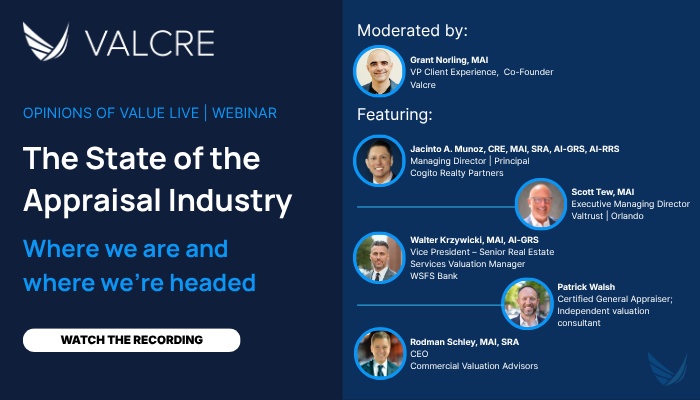
The debut session, “State of the Appraisal Industry: Where We Are and Where We’re Headed,” tackled the big one first: where does the profession actually stand right now, from the people doing the work every day.
Watch the full recording below and read on for the recap.
Who was in the room
Grant Norling, co-founder and VP of Client Experience at Valcre, moderated the discussion.
He was joined by five panelists with deep, varied experience across the industry:
- Rodman Schley, MRI, SRA, CEO, Commercial Valuation Advisors
- Jacinto A. Munoz, CRE, MAI, SRA, AI-GRS, AI-RRS, Managing Director | Principal, Cogito Realty Partners
- Scott Tew, MAI, Executive Managing Director, Valtrust | Orlando
- Patrick Walsh, Certified general appraiser; Independent valuation consultant
- Walter Krzywicki, MAI, AI-GRS, Vice President – Senior Real Estate Services Valuation Manager, WSFS Bank
Asked to sum up the state of the industry in a single word, the panel offered: evolving, reinvented, transitional, automating, and preparing. That range set the tone for an hour of candid, sometimes differing perspectives.
Volume is up, but “activity” and “recovery” aren’t the same thing
After a long stretch of compressed transaction volume, panelists reported real signs of life. Walt Kryzwicki noted his bank’s appraisal volume is running roughly 15 to 16 percent above last year’s first half, and Rodman Schley echoed the uptick from the appraiser’s seat in Colorado.
Jacinto Munoz had a slightly different perspective. Much of what he’s seeing coming through the door, he explained, is driven by necessity rather than a genuine market rebound: maturities, refinancing pressure, workouts, and extensions on loans that simply have to be dealt with, not new deal flow. He expects more typical transaction volume to return over the next 12 to 24 months.
Walt added a related shift on the lending side: appraisals are increasingly being ordered earlier in the loan process, with market and property analysis playing a bigger role in underwriting and risk assessment, not just as a final step before closing.
Beyond lending: Litigation, tax appeal, and market rent work
Several panelists have deliberately diversified into non-cyclical work such as litigation, tax appeal, and eminent domain. Scott Tew pointed to tax appeal as an especially robust area right now, particularly around overvalued office assets. Jacinto agreed that litigation presents an opportunity, and both he and Scott were clear that this isn’t work you jump into overnight. It takes mentorship, a track record, and a strategic, bite sized approach to building credibility with attorneys and clients.
Capacity isn’t the real constraint, competency is
The panel largely agreed the industry isn’t facing a raw capacity shortage today. The harder problem is developing the next generation of skilled appraisers. Jacinto and Rodman both spoke to the value of mentorship and training, and to ongoing debate over college degree requirements. Rodman’s take: replace the degree requirement with more appraisal specific coursework, not less rigor.
Rodman also delivered one of the session’s most memorable lines: train your competition. Investing in other appraisers, he argued, builds the public trust the whole profession depends on.
AI: A real tool, not a shortcut around fundamentals
Unsurprisingly, AI came up throughout the discussion. Patrick Walsh offered a useful framework: AI is strong at extraction and can be a solid writing and review partner, but it deserves much more caution when used for independent research, especially in litigation work where every fact needs to be verifiable.
Scott Tew described his role as a kind of “circuit breaker,” vetting how his team uses AI tools and making sure client data stays secure. The consistent thread across the panel was that AI can meaningfully expand capacity, but it can’t replace a real understanding of valuation methodology. Several panelists warned that appraisers who lean on AI without grasping the fundamentals underneath it pose a real risk to public trust.
A profession in a different place, not necessarily a worse one
Asked whether the profession is better off, worse off, or just different, the panel leaned toward different, and mostly optimistic. Rodman called this one of the most exciting times he’s seen in nearly three decades as an appraiser. Jacinto reframed the capacity conversation entirely: the industry doesn’t have a capacity problem, he argued, it has a competency problem, and the appraisers who master new tools while holding onto sound judgment are the ones who will thrive.
Walt added a call to action: more appraisers need to speak up publicly about the profession, rather than leaving that conversation to brokers, lenders, and others outside the field.
The single biggest threat, according to the panel
Asked to name the biggest existential risk to the profession over the next five years, the panel converged on a common theme: training and mentorship. Patrick and Rodman both pointed to the risk of new appraisers learning to operate AI tools without understanding the valuation principles behind them. Scott echoed the same concern from a different angle, the danger of using a tool without being able to explain what it actually did. Walt warned against clinging to old habits instead of adapting. And Jacinto closed with a distinction: technology can commoditize repeatable tasks, but it can’t replace the judgment appraisers bring to complex, unusual, or contested assignments. That judgment, he said, is what the profession needs to protect.
Watch the full conversation
This recap only scratches the surface of an hour packed with insight from five seasoned professionals. Watch the full recording above to hear the complete discussion in their own words. A big thank you to our panelists for a lively and candid discussion, and the audience who joined us!
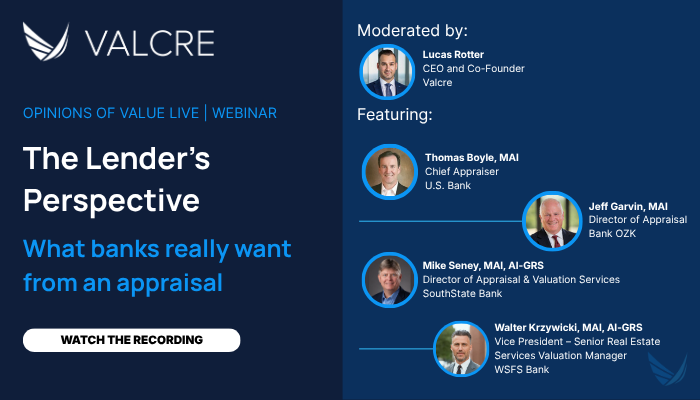
Our next session of Opinions of Value Live will dig into the lender’s perspective and what banks really want from an appraisal. Details on that session are coming soon.