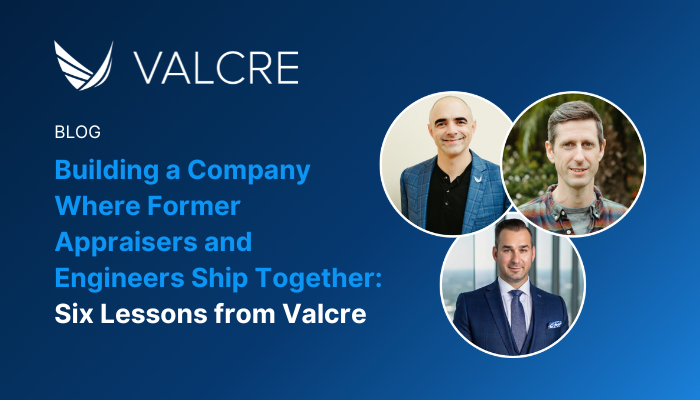
The founders of Valcre, Lucas Rotter, Kris Owens, and Grant Norling, bring together decades of appraisal practice, enterprise product experience, and industry leadership. As Valcre celebrates its 10-year anniversary, here are the lessons they’ve learned from building software at the intersection of two very different worlds.
Most vertical software fails the same way: it’s built by people who understand technology but not the profession, or by industry veterans who understand the work but not how to build scalable software. The result is either a polished product that breaks under real-world complexity, or a digitized version of the workflow that was already broken.
Commercial real estate appraisal is a particularly unforgiving place to get this wrong. The work demands that a single professional hold market conditions, methodological choices, property-specific factors, regulatory requirements, and professional liability in their head simultaneously (and under deadline) and produce a defensible opinion they’ll sign their name to. The tools that support that process either genuinely understand it, or they don’t. Appraisers can tell the difference within the first complex assignment.
Valcre was built by people who have lived on both sides of that equation. Lucas Rotter came up as a valuation professional before becoming a builder. Grant Norling spent over twenty years in production appraisal, ran his own firm, and worked on building valuation technology from inside the profession. Kris Owens brings enterprise software and product leadership experience from Microsoft and beyond. Together, they’ve built something the appraisal industry doesn’t often get: software designed with an insider’s understanding of the work and an engineer’s understanding of how to make it scale.
The lessons below are the product of real disagreements and hard tradeoffs between those perspectives over ten years.
1. Listen to the pain. Don’t build the prescription
Appraisers are expert diagnosticians. They know exactly where the workflow breaks, where manual steps pile up, and where the tool stops serving the work. And that insight is irreplaceable. The opportunity is making sure that knowledge shapes software that isn’t constrained by the limitations of the past.
As Kris Owens explains, legacy workflows are often “shaped by years of workarounds” and outdated tools, which means the most powerful thing modern software can do is take the pain appraisers have identified and solve it better than the old tools ever could. This means the product team’s job is to treat user feedback as a signal about the underlying problem, and combine it with their expertise in designing durable, next-generation software solutions.
That’s where the partnership matters. Appraisers bring an unmatched understanding of where the profession needs to go. Product brings the software expertise and engineering capability to get it there. As Lucas Rotter puts it: “Do not assume the first thing a user asks for is the real answer, and do not assume your engineers can infer the nuance on their own.” When those two things work together, deep domain knowledge and modern software thinking, the result isn’t just a better tool. It’s a genuine step forward for the industry.
2. The translator is your most important hire
Neither domain expertise nor engineering talent alone is enough. As Kris Owens describes it, the hardest role to find is “the person who can translate between appraiser and product needs into usable software.” That person must understand the appraisal workflow deeply enough to identify what actually matters and know the product well enough to avoid simply recreating an inefficient process in software.
Lucas Rotter is something of a test case: a former appraiser who became a builder. His candid assessment is that even carrying both in one person doesn’t dissolve the tension. “The appraiser in me wants to build the exact workflow I know, the one that feels right because I lived it for years,” he says. “The builder in me knows that is usually a trap.” The value lives in holding that tension productively, and somebody has to own that translation relentlessly.
3. Edge cases aren’t edge cases. They’re Tuesday.
As Lucas Rotter puts it plainly: “When software gets built without real appraisal context, it demos beautifully and falls apart on the second assignment. The edge cases are not edge cases to the appraiser. They are Tuesday.” Software that handles the clean office building and chokes on a hospitality deal, a partial interest, or a regional methodology that doesn’t fit the template isn’t a minor gap. It’s a product that doesn’t serve the profession.
Grant Norling frames the same point in terms of what it takes to earn trust: knowing “why a hospitality assignment is not just a more complicated office building,” why a specific regional methodology matters and “is not just a quirk to be rationalized away,” and understanding “the weight of what it feels like to sign your name to a report.” That knowledge can’t be inferred from the outside. It has to be lived.
4. Build a platform, not a digitized spreadsheet
Lucas Rotter identifies two failure modes in vertical software, and both are common: “Domain expertise tells you what to build. It does not tell you how to build something that holds up for hundreds of firms doing the work hundreds of different ways.” Build without domain expertise and you get something that looks good and falls apart under real complexity. Build with domain experts driving product but no real engineering partnership and you get a digital spreadsheet; functional for the person who built it, brittle for everyone else.
The answer isn’t picking a winner between structure and flexibility. In Kris Owens’ framing, “the platform needs to be strong enough to guide the workflow, but flexible enough to support the real variation that exists across the industry.” That means robust core workflows for standard scenarios, meaningful customization where the market genuinely varies, and the discipline to tell the difference between variation that’s real and variation that’s just habit.
Templates were one of the clearest examples. Firms needed flexibility because regional practices, specialty property types, and reporting requirements genuinely vary. But unlimited customization would have produced a brittle platform that could not scale. The solution was to build guided core workflows while preserving flexibility where the profession truly required it. That gave firms meaningful customization without forcing every customer into either a generic template or a one-off system.
5. AI amplifies domain expertise, or it quietly erases it
AI is the most significant near-term lever for reducing appraisal friction, particularly as it relates to data entry, first-draft narrative, and comparable-property searches. But as Kris Owens cautions, “the risk with AI is building generic automation that looks useful on the surface but ignores appraisal nuance. Appraisal still requires judgment, review, and context.” The appraiser owns the opinion of value; they sign their name to it and defend it. No model does that.
Lucas Rotter draws the line clearly: “The wrong use is automation that quietly makes the judgment for them and hides it behind a clean interface. That is not efficiency, that is risk.” Knowing where that line sits is a domain question, not an engineering one, and it can’t be answered from outside the profession. Getting AI right in appraisal software requires the same insider understanding that getting the rest of the product right does.
6. Technology should give appraisers back the work they chose to do
Grant Norling is direct about what technology is actually for: “Technology done right is not about making appraisers faster. It is about giving them back the parts of the work that drew them to the profession in the first place.” Most appraisers did not enter the profession to format reports or hunt for comparable data buried in a two-year-old spreadsheet. The manual work did not come with the job because it had to. It came because nothing existed to carry it.
When that changes, the downstream effects go beyond efficiency. As Grant Norling explains, “An appraiser who is not buried in administrative tasks has more time to think carefully, question assumptions, and catch the thing that does not quite add up before it makes it into the final report. The quality of the opinion improves not because the appraiser got smarter, but because the workflow stopped getting in the way.” That is the real case for building software that understands the profession from the inside. Not just faster output, but better work.
That is the standard we are building toward at Valcre: not software that replaces appraisal judgment, and not software that simply digitizes old habits, but a platform shaped by the people who understand the work and the engineers who know how to make it scale.
This shift matters beyond individual efficiency, it also has a significant impact on the work-life balance problem the industry has quietly struggled with for years. “This profession asks a lot of people, and it has for a long time,” reflects Grant. The long hours demanded of appraisal professionals aren’t just about volume, much of that time is consumed by the friction felt in manual steps, rework and managing legacy tools.
When you reduce this friction with a platform that’s built for the appraisal profession, you don’t just improve throughput. As Grant shares, the resulting work-life balance is far more powerful, for individual appraisers and the profession itself: “You give people their evenings back. You make it possible to take on a complex assignment without it consuming the entire week. That is not a small thing for retention, for recruiting, and for the long-term health of the profession.”
Learn how Valcre helps appraisal teams reduce workflow friction, strengthen consistency, and give professionals more time for the judgment that matters most. Schedule time with our team today.