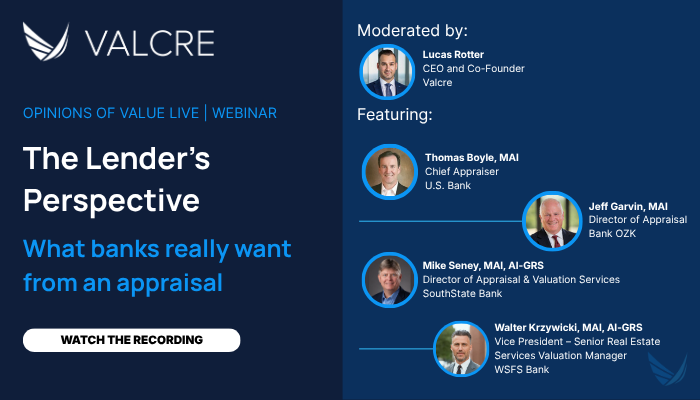
Opinions of Value: Live is back. After our first session asked appraisers where the profession stands, the second session in the series flipped the script. “The Lender’s Perspective: What Banks Really Want From an Appraisal” brought together four senior valuation leaders from major financial institutions to share what they need from a report, what frustrates them, and what appraisers most often get wrong.
Who was in the room
Lucas Rotter, CEO and Co-Founder of Valcre, moderated the discussion. He was joined by:
- Thomas Boyle, MAI, Chief Appraiser, U.S. Bank
- Jeff Garvin, MAI, Director of Appraisal, Bank OZK
- Mike Seney, MAI, AI-GRS, Director of Appraisal & Valuation Services, SouthState Bank
- Walter Krzywicki, MAI, AI-GRS, Vice President – Senior Real Estate Services Valuation Manager, WSFS Bank
All four are former fee appraisers who understand both sides of the desk.
The biggest misconceptions, in a word or two
Lucas opened by asking for the biggest misconception appraisers have about what banks need. Mike said brevity: banks don’t want a 300-page report, but they do want completeness. “Words are cheap, so write a few more.” Tom said speed over credibility: a request for a quick turnaround always assumes a credible report. Jeff said value: he’s no longer just reading the number, he’s reading everything. Walt said agreement: a reviewer’s job isn’t to agree or disagree with the value, but to confirm the assignment was developed and reported appropriately.
Tell the whole story, consistently
What makes a report sail through review? The panel was aligned: a clear narrative with no surprises. Walt wants the story told from the transmittal letter through the reconciliation, and Mike doesn’t want to discover something new on the last page.
Jeff’s most common snag is inconsistency between the front and back of the report, such as a market analysis describing a stable market followed by aggressive rent growth assumptions in the valuation. Tom added that strong reports address the issues raised in the RFP and engagement letter, include the property’s sales, income, expense and occupancy history, and use comparables that have actually been confirmed.
Communication is where the process breaks down
Mike named communication as the most common breakdown, and the easiest to fix. Tom admitted problems can start with the bank itself, when business line requests aren’t fully baked. If what you find on site differs from what was described, pick up the phone.
Jeff estimates one in three or four assignments hits an information problem. Tell him early and he can advocate for you and arrange an extension. Tell him three days before the due date and “I am a pumpkin.” Walt added that deadlines on properties under contract are especially rigid, because a late appraisal can hold up a sale.
Bigger banks, bigger problems
On portfolio assignments and volume spikes, team size shapes the challenge. Tom said larger teams must work hard to keep reviewers consistent on what is material. Jeff and Walt described smaller teams handed a stack of reports and a tight sign-off window.
Your report lives longer than you think
Walt noted that bank appraisal departments, once largely administrative, are now run by experienced appraisers, and credit teams rely on report data for major lending decisions. Mike shared something that surprised him when he moved from the field to the bank: once a report is approved, the bank owns it, and it may be scrutinized by auditors, examiners and executives for years. Jeff added that he’s had to defend reports more than two years old.
Tom summed it up: credit approvers view appraisers as unbiased, competent professionals, and what they say carries real weight. It’s not just the value. It’s the income, the expenses and the property characteristics too.
The appraisal as a source of truth
A theme that ran through the session was the appraisal becoming a “source of truth” about the asset. Jeff pointed to the BRAVE file, which all four panelists now request in their engagement letters, as a way to capture and verify report data. He is also tracking insurance costs by region to inform underwriters. Mike explained that property type and size now flow from the appraisal into the bank’s core systems.
Walt noted that renewals, maturities and workouts make the market analysis even more important. If you appraised a property three years ago, don’t anchor to your old number. Explain what has happened in the market since.
Tom borrowed a well-known banking line: when the tide goes out, you find out who’s been swimming naked. AI will be that tide, making inconsistencies easy to spot and freeing reviewers to focus on valuation, flood risk and remaining economic life.
One piece of advice
Lucas closed by asking for something appraisers could change tomorrow.
- Walt: Don’t neglect the front half of the report. Be the local market expert, especially in smaller markets that national firms may not cover as well.
- Mike: If you’re not using AI, you’re already late. Use it carefully, and consider building prompts or agents to review your own work before it reaches the bank.
- Tom: Confirm your data, because market knowledge is the step AI can’t replicate. And read the question. The RFP and engagement letter are an open book test.
- Jeff: Know your client. Bank OZK scores its vendors, and fee comes fourth, behind quality, communication and on-time delivery.
Standing out as a smaller firm
In the Q&A, Walt was asked how a small or independent firm can stand out with a lender. His answer: it’s about the individual writing the report, not the logo on it. Get involved in the profession and build your network, because today’s fellow appraiser could be tomorrow’s bank appraisal manager.
This recap only covers the highlights. Watch the full recording to hear the complete discussion.
Watch the full conversation now
Want to keep the conversation going? Jeff Garvin and Lucas Rotter are featured speakers at the BRAVE Summit, hosted by FIVA in November. Register here.
Our next session of Opinions of Value Live will focus on growing culture and talent at your firm. Check out all of upcoming webinars and watch past webinars on-demand here.